
Prompt
- Pay attention to all of the ads you receive online. Pick 3 and research how they were served to you. How might they have identified you? What ad network do they come from? How does the bidding process work?
Instagram Ad Examination
In my internet experience, I have either become numb to the ads served up to me or my AdBlocker/YouTube Premium prevents me from seeing the more noticeable stuff.
However, I noticed the ads I see the most common while online is on Instagram. On Instagram, ads are served as camouflaged posts that blend into the scrolled feed of suggested videos and followed content. Only a measly “sponsored” line of text underneath the account’s name indicates an ad (other than the obvious content/account name).
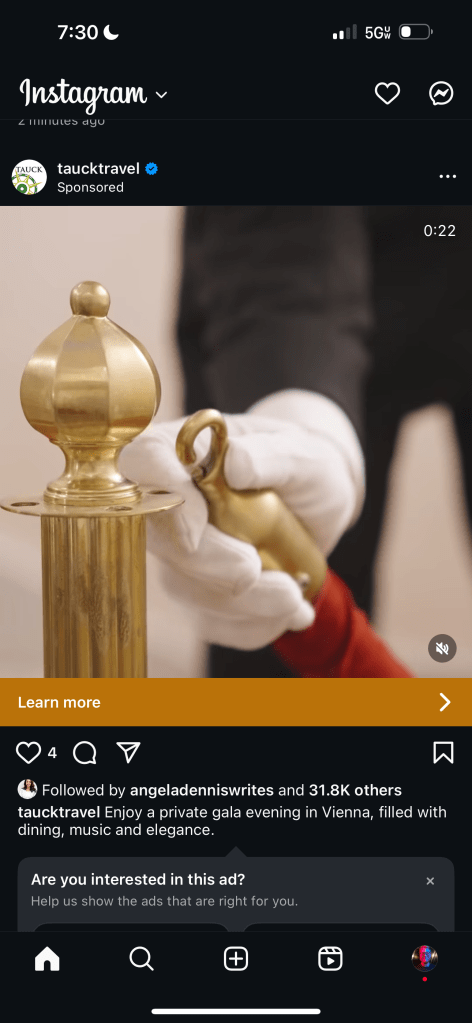

This measly “transparency” is what struck me about Meta’s whole dealing with Instagram ads. Technically, I can learn more about each Instagram ad by clicking on the three dots in the top right corner. Then, I tap on “Why you’re seeing this ad.”
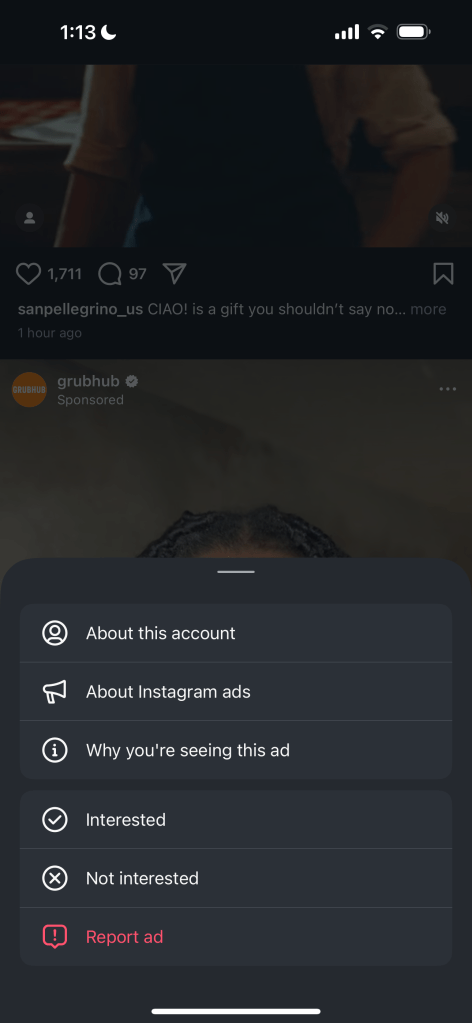
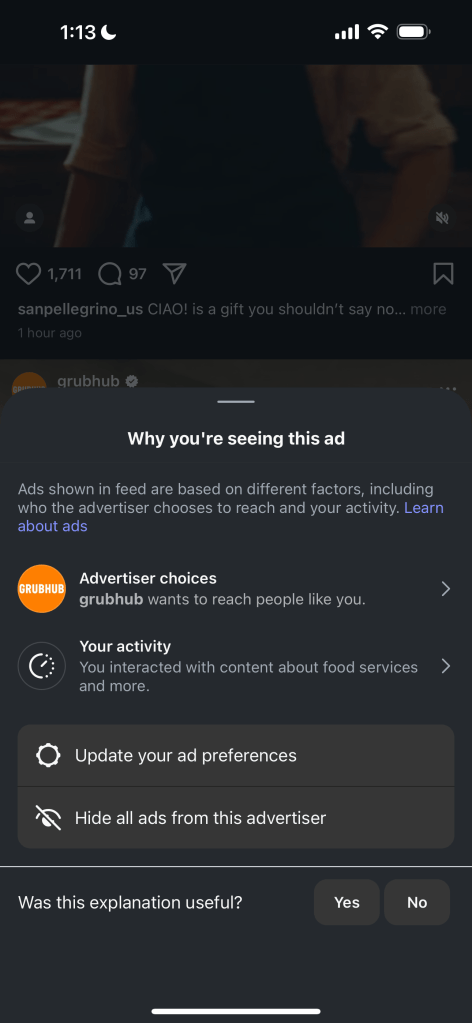
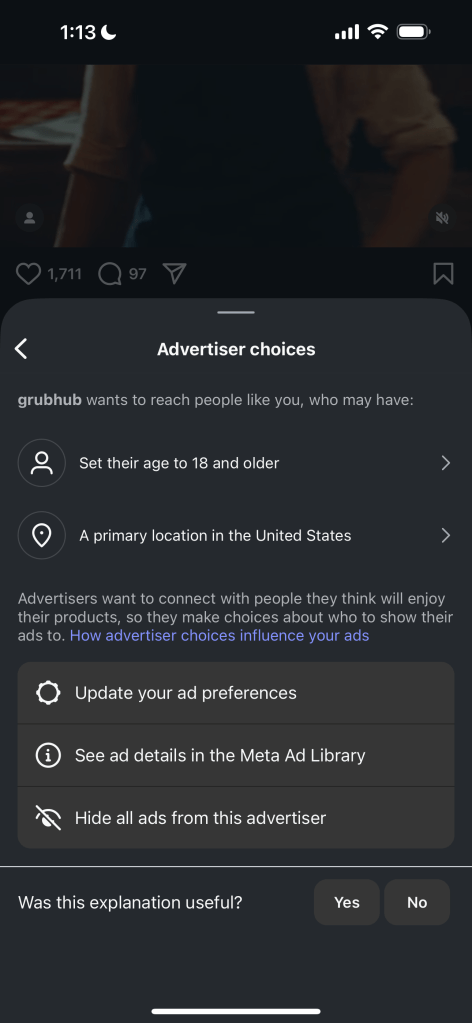
After clicking on why “grubhub wants to reach people like [me], ” I find that it’s because I’m older than 18 and I’m in a “primary location in the US.” That is the most generic and opaque reasoning to serve a Grubhub ad to me, when I suspect the more likely reason is because I’m a graduate student who’s used Uber Eats a lot more since moving to NY. I’m sure Meta has that data from Uber Eats or American Express.

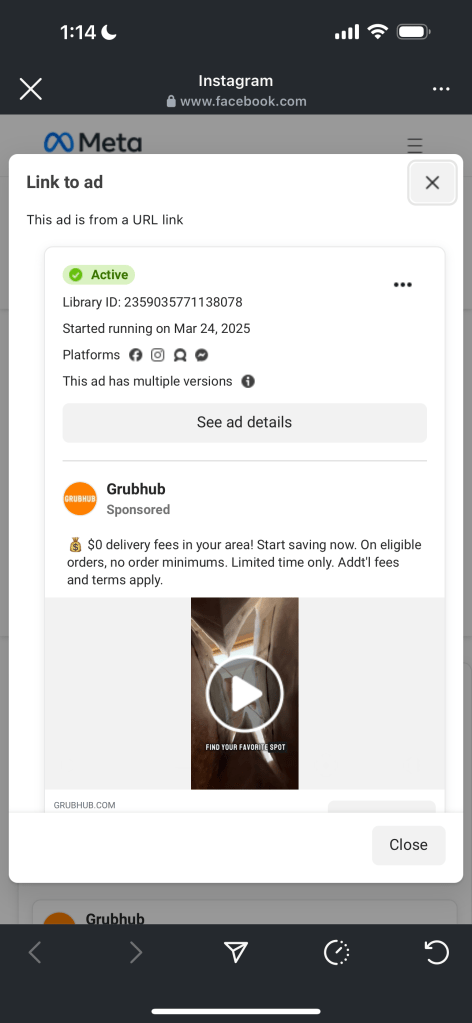
The other button labelled “my activity” when selected says that I interact with food content on Instagram, which I do not. I watch Youtube videos of food so I don’t know what Google has to do with any of my Meta ads, unless these companies share data back and forth. Maybe they work together since they’re an oligarchy for digital advertising. Meta’s shallow veneer of phony transparency in their ad process (probably court ordered) engenders more frustration in me than if they said nothing at all.
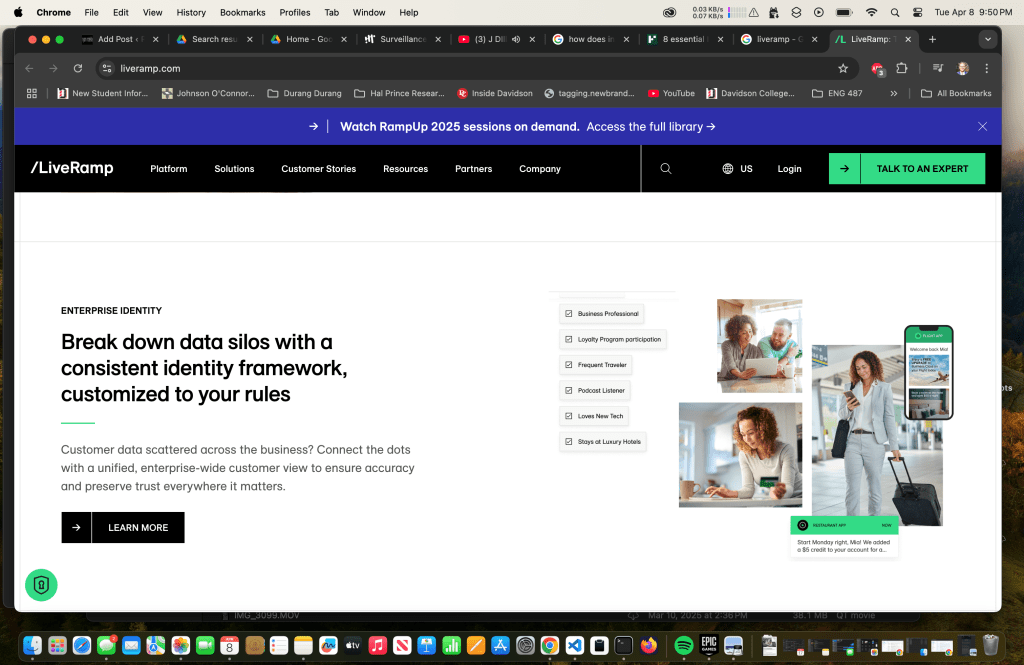
Speaking of corporate collaboration, I was served an Amazon ad on Instagram. When I clicked to learn more about that generic Amazon ad, the ad said I was older than 18, spoke English, lived in a “primary location,” but this ad also said I have been on a “hashed list that insideamazon used.” When I researched further, Meta says: “LiveRamp uploaded a hashed list with your information to Facebook. We matched that information with you.”


I don’t feel particularly pleased on being on a hashed list. This drives home Shoshana Zuboff’s point that customers and their data are the raw material for surveillance capitalism to process and serve to companies (the B2B model, Business to Business). Of course, upon researching, LiveRamp is a advertising analytics company that helps companies “connect the dots” about their customers. LiveRamp is a fitting name for a company that serves as a treadmill for consumers to walk faster and faster into more targeted ads that promote more and more gluttonous consumption online.
The third ad I saw reminded me that there is a lot of AI that has to be guiding these ad placing decisions.
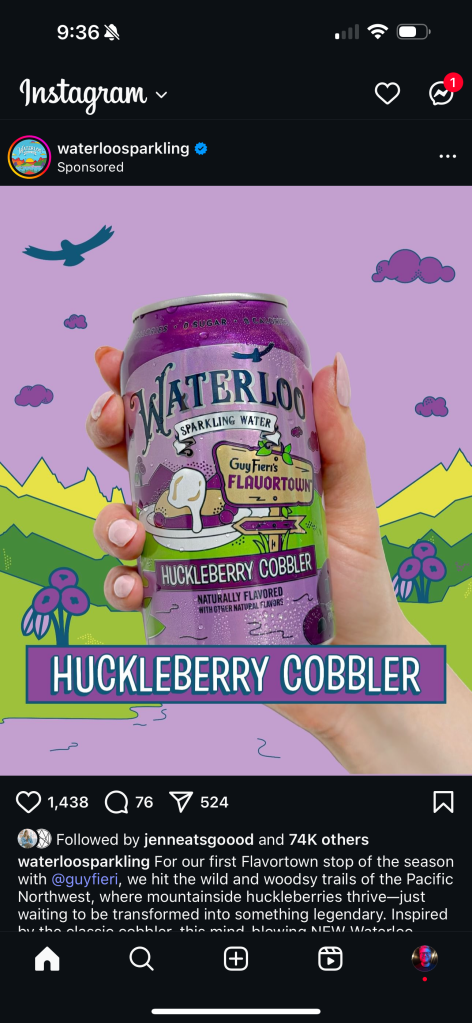

What an unholy creation served to my feed (I would try it though). I do love seltzers as I’m sure my credit card data shows very well to Meta because how else would they know this. I do not search for seltzers online in my free time. I know where to go in-person. Also, I think my group message history factors into this because my undergraduate friends have a groupchat named after Flavortown (the name we also gave our Senior year apartment). However, the reason I suspect AI is involved because my related activity for the Guy Fieri Huckleberry Cobbler Waterloo seltzer was interacting with posts about food, music, comedy, travel, sports, and cameras. So according to them because I looked at any topic on Instagram, the algorithm determined I wanted the Guy Fieri Huckleberry Cobbler Waterloo seltzer. As if all my other data from my spending and messages have nothing to do with it. I don’t like surveillance, but at least Meta and Google could be more honest about what they do and how evil they are.
Reflection on Zuboff
Prompt: Zuboff warns of the coming instrumentarium society. Are you worried? Answer in a short blog post.
Zuboff argues well that surveillance capitalism feeds off of people and their behavior as the raw material for producing data for other businesses to predict/manipulate buyer’s behavior. In her words: “surveillance capitalism preys on dependent populations who are neither its consumers nor its employees and are largely ignorant of its procedures.” (PDF) In the new game of surveillance capitalism, I feel akin to a lab rat in a digital maze, being offered multiple cheeses and never led to satisfaction. But there’s no experiment. It’s just profit, speculation, and gambling. I think we are in the instrumentarium society already.
Obviously, I am worried. Surveillance capitalism has eroded any semblance of niceties in the liberal order. The rampant value extraction and colonization of every second of our lives, decisions, and information has eroded our institutions, social fabric, and ability to understand most processes since they have been abstracted to such an acute degree. However, this system is an ouroburos, eating itself in contradictions as capitalism tends to be. Nothing is being produced under surveillance capitalism. It is just pure extraction and relies on people’s behavior to create value and people are increasingly being limited in their behavior and spending. What’s there to predict if people are unable to do anything about the failure of the US empire, climate change, and so on so forth?
I do disagree with Zuboff on two accounts. One, I know this was written pre-pandemic, but I cannot take any appeal to lawmakers seriously anymore. The lawmakers have proven themselves to be thoroughly unserious. Second, I also disagree with the assumption it’s impossible to rebuild infrastructure without the internet. Zuboff writes, “This is the Scylla and Charybdis of our plight. It is nearly impossible to imagine effective social participation ––from employment, to education, to healthcare–– without Internet access and know-how, even as these once flourishing networked spaces fall to a new and even more exploitative capitalist regime.” Amidst the slightly indulgent literary references and apt analysis, Zuboff cannot imagine social participation without the internet. I argue non-internet social participation is one of our only hopes, and this has been a constant power throughout history. We have the ability to connect with each other as our predecessors have: in our physical communities, educating each other, reducing harm for one another. There’s nothing stopping us from doing so. We only have to walk away from the internet. And doesn’t that sound nice.
 Ryan Rotella
Leave a comment