Prompt:
Progress update 1: Inquiry space + inspiration repository.
- Inquiry space. Look at your concept map from class. What are your key areas of interest? These can be fields, themes, media, techniques. Draw a diagram describing your inquiry space. The idea is that it serve as a map, helping guide your research and, later, your creative experiments. Here are some examples.
- Start building your repository for inspiration. For your areas of interest: what terms are used, who are the people working in this field, where do you find their work, what looks interesting? Here are some suggestions on how to find sources to add to your list:
- Browse in the library*, a bookstore, looking for relevant books, journal articles, and other media. Keep track of what you find, following a format like this (more thorough), or like this one (more lightweight).
- Browse online, talk to peers. Find relevant media – artworks, films, games, exhibitions, concerts, talks, documentaries, podcasts, others – and add them, too.
- Browse the ITP Thesis Archives, find 2 or 3 projects that resonate with you. Watch their presentations.
- Find professors at NYU who are experts in related areas. See if they will meet you and discuss their work, field or, once you’re ready, your project idea.
What is an Inquiry Space?
An inquiry space is essentially my creative research territory—a visual map of the fields, themes, media, and techniques that spark my curiosity and will drive me toward my thesis. Rather than diving randomly into an overwhelming amount of research, mapping my inquiry space helps me identify patterns in what draws me in, discover connections between seemingly disparate interests, and create a focused framework for exploration.
From Hunch to Inquiry Space
But I was still overwhelmed. How do I craft a project that represents my time at ITP? How could one project do that? Luckily, I am not alone in that question. Thank you to the ITP Pre-Thesis advisors for giving the “From Nothing to Something” exercise—a free-associative process that revealed unexpected connections and themes in my thinking.
Starting with My Hunch
I began with a single idea that has interested me for awhile:
An immersive Experience where the audience decides together.
Through free association and thinking of my project idea across different categories—forms, materials, scale, emotions, verbs, motivations—I noticed familiar interests of mine but also some surprises.
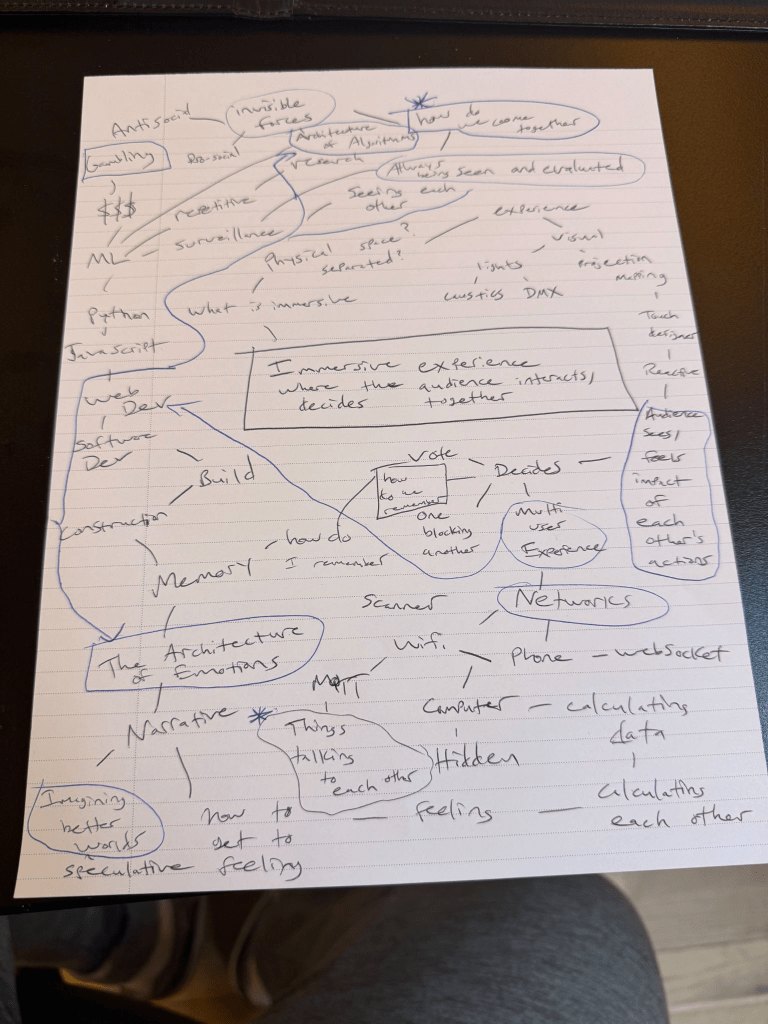
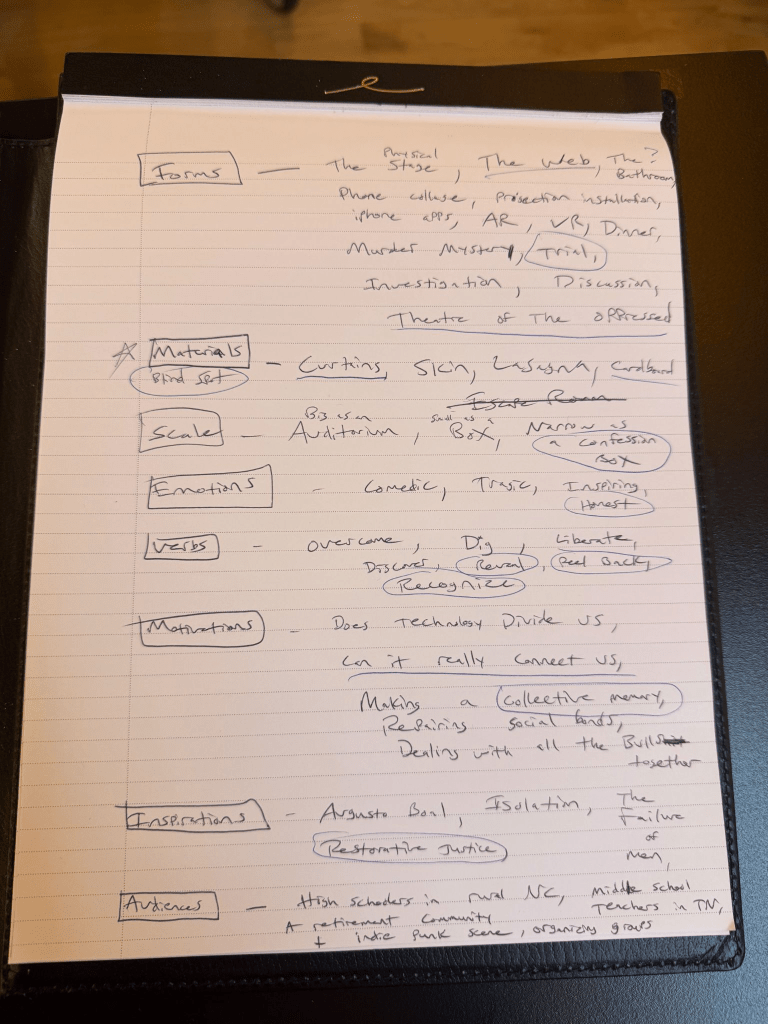
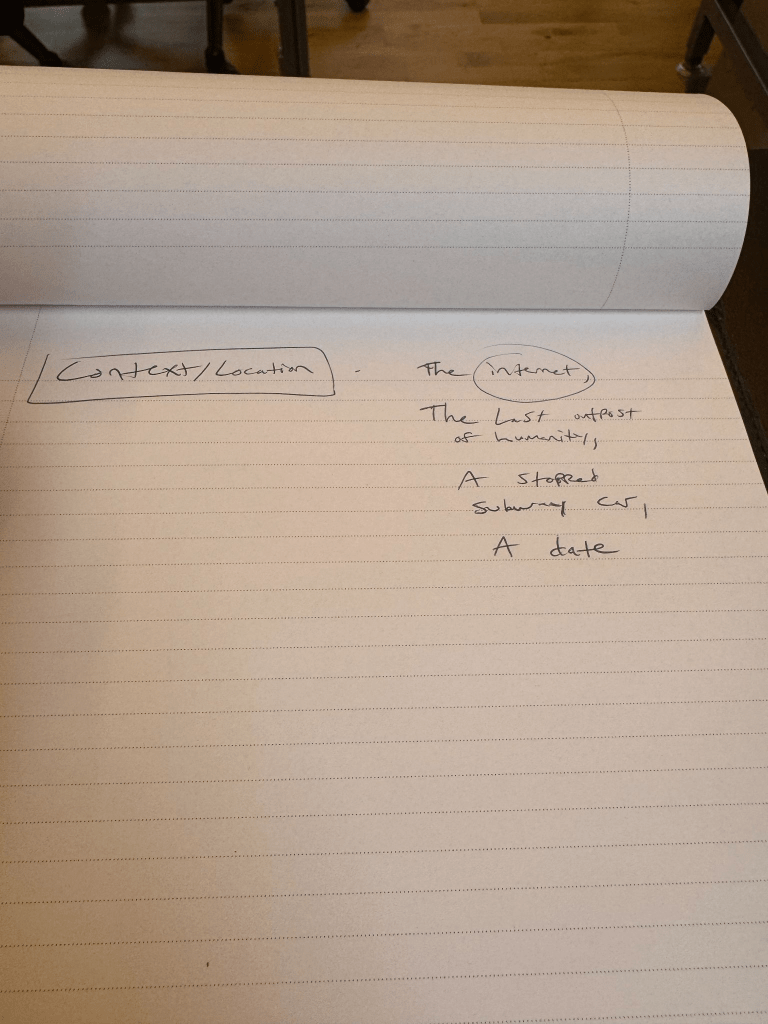
My exploration revealed recurring themes around:
Immersive Experiences: How can audiences participate in collective decision-making? What happens when the boundary between observer and participant dissolves?
Technical Implementation: My concept map shows the technical backbone I’m exploring—from TouchDesigner and projection mapping to web development, servers, and networks. I’m interested in how MQTT, WiFi, and Bluetooth can create responsive environments.
Physical and Digital Integration: I’m mapping connections between physical design elements and digital interfaces, exploring how audiences can interact in-person with the aid of technology through voting mechanisms and game design.
Storytelling and Performance: The map reveals my interest in different narrative forms—specifically immersive site-specific theater. I’m particularly drawn to the “Theatre of the Oppressed” by Augusto Boal as a form of collective storytelling and exploring questions around restorative justice.
Social Dynamics and Ethics: I’m fascinated by the tension between being watched and being connected, between antisocial tendencies and the need for community. What feels “invasive” versus what creates genuine connection? Can those be separated in the online and physical spaces we inhabit now?
Visualizing My Inquiry Space
After working through the free-association exercise, I translated my handwritten explorations and iterated into a digital concept map using Figma.
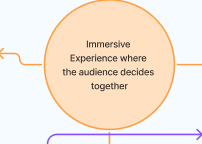
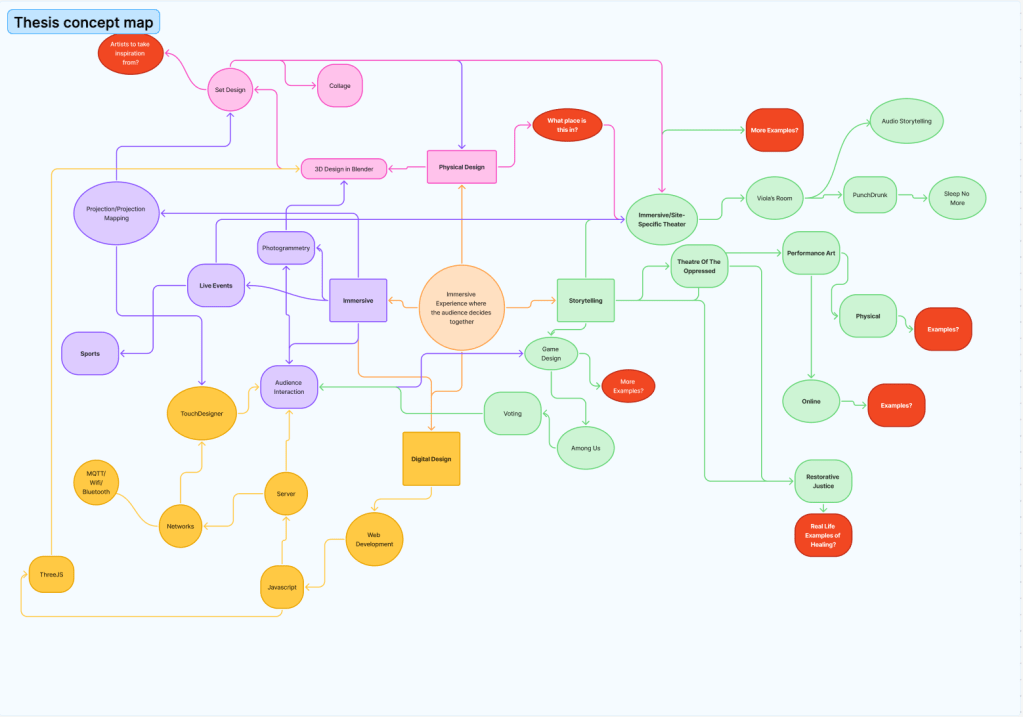
This core concept sits at the heart of my inquiry space, with various branches extending outward to explore different facets and applications.
Identifying My Core Themes
My Figma concept map is organized these into color-coded clusters:
- Technical systems (yellow): Networks, servers, web development, programming languages
- Physical implementation (purple): Live events, sports integration, projection mapping, audience interaction
- Creative mediums (green): Storytelling approaches, game design, performance art, audio experiences
- Research questions (red): Areas where I need more examples, ethical considerations, real-world applications
The visual map helps me see not just what interests me, but how these interests connect and where there might be gaps in my understanding that need further research.
Building My Research Repository
Once I identified my core interests, I began building a comprehensive repository of inspiration and reference materials. This isn’t just about collecting—it’s about creating a structured system for discovery and connection-making.
Learning from Past Work
ITP Thesis Archives: I was tasked to find 2-3 projects in the ITP Thesis Archives that resonate with my inquiry space. I dove deep by watching their presentations, and noting techniques or frameworks I might adapt for my own work.
Three projects particularly stood out to me as they each explore different aspects of my core interests:
“Continuum” by Vio Zhu – An audio-reactive architecture projection mapping performance on the Lille Palace of Fine Arts, transforming its architecture into a living instrument through real-time visuals, lighting, and rhythm-driven storytelling. This project resonates with my interest in immersive experiences and the technical implementation I’m exploring—particularly the use of TouchDesigner for audio-reactive design and projection mapping. What draws me to this work is how the building’s architecture structure becomes an instrument in itself, responding to the rhythm and emotion of the music, which aligns with my vision of spaces that respond to collective input. I also like how she prototyped using a physical model as well as an Unreal setup.
“my memories are blue and green and teal” by Henrique Bastos Stockler – I’m particularly interested in how Henrique’s wonderful work combines physical interaction (3D model of childhood home) with projection mapping to create such an intimate experience. The modularity and focus on reconstructing his childhood house, from scratch and from memory speaks to questions I have about collective versus individual memory and experience.
“The Play” by Junqi Luo – This interactive performance system directly addresses themes central to my inquiry space: how our identities are shaped, distorted, and sometimes broken by the gaze and expectations of others. The project integrates motion capture, projection, and player input to question how much of the Self is formed through external gaze, which connects to my interest in audience agency and collective decision-making.
These projects demonstrate different approaches to the technical challenges I’m considering—from large-scale projection mapping to intimate interactive installations to real-time performance systems with audience input. The latter 2 projects grapple with questions about identity, memory, and the relationship between individual and collective experience that are central to my own inquiry space.
Building Academic Connections
Expert Conversations: I have started and need to continue identifying professors at NYU and beyond who are experts in my areas of interest. I need to reach out to discuss their current work and research, the broader field and its evolution, and my emerging project ideas once I’m ready.
I’ve identified several key faculty members whose expertise directly aligns with different aspects of my inquiry space:
Aidan Nelson – Aidan specializes in interactive 3D web development and is a creative developer who collaborates with theaters, museums and cultural spaces to create more engaging ways for people to connect in physical and hybrid art spaces. His work building web-based live performance venues and developing open-source tools for emerging technologies aligns perfectly with my interest in digital interfaces for collective experiences.
Tom Igoe – I want to consult Tom particularly about networks and how devices talk to each other. His knowledge of how to sense and respond to human physical expression is essential for the interactive systems I want to build.
Mia Rovegno – I’m currently taking her class on immersive storytelling. Mia’s expertise in theater directing, narrative forms, and immersive experiences directly connects to my interest in creating stories where audiences participate in decision-making.
Ami Mehta – I’m also currently in her class focusing on motion capture, XR, and cultural storytelling. Her work developing culturally-rooted speculative designs provides a framework for thinking about how technology mediates social experiences.
Shariffa Ali – I worked with Shariffa in a musical theater XR hackathon this past summer, and her expertise in theater and immersive theater is invaluable. As a faculty member at Princeton’s Lewis Center for the Arts with experience in immersive performances and directing at institutions like The Public Theater, she brings deep knowledge of how technology can enhance live performance and storytelling.
These conversations provide invaluable insights and potentially open doors to collaboration or mentorship across the technical, artistic, and conceptual dimensions of my work.
Key Artistic Influences
Beyond direct academic mentorship, I’m also drawing inspiration from established artists whose work demonstrates the possibilities within my inquiry space:
Joanie Lemercier – His work with projections and interactive projections has been a major influence as I start my projection design journey. His practice of working with light in space, often projecting on unconventional surfaces and using technology to alter perceived reality, provides concrete examples of the large-scale beautiful immersive experiences I’m interested in creating.
Organizing My Repository
As I gather materials, I’m maintaining organization through multiple complementary systems that serve different research needs:
Primary Repository: Google Sheets
I’ve set up a Google Sheets repository based on Cesar’s academic research methodology, which includes columns for:
- Media Type: Whether it’s an ITP Thesis Archive, Website, Book, etc.
- Resource Name: The specific title or project name
- Relevance: High/Medium/Low based on how directly it connects to my inquiry space
- Author(s): Who created the work
- Year: When it was published or created
- Tags: Keywords that connect to my concept map (Art, Performance, Play/Games, Systems Design, Unreal Engine, Mocap, Culture, Installation, etc.)
- Link: Direct access to the resource
- Thoughts: My personal reflections on how it connects to my work

Academic Management: Zotero
I’ve also set up Zotero for more robust bibliographic management, particularly useful for academic papers, books, and sources that require formal citation. Zotero allows me to:
- Automatically capture bibliographic information from websites and databases
- Organize sources with tags like “inspiration,” “projection,” and “touchdesigner”
- Store PDFs and web snapshots for offline access
- Generate properly formatted citations when needed
- Take detailed notes and annotations on sources
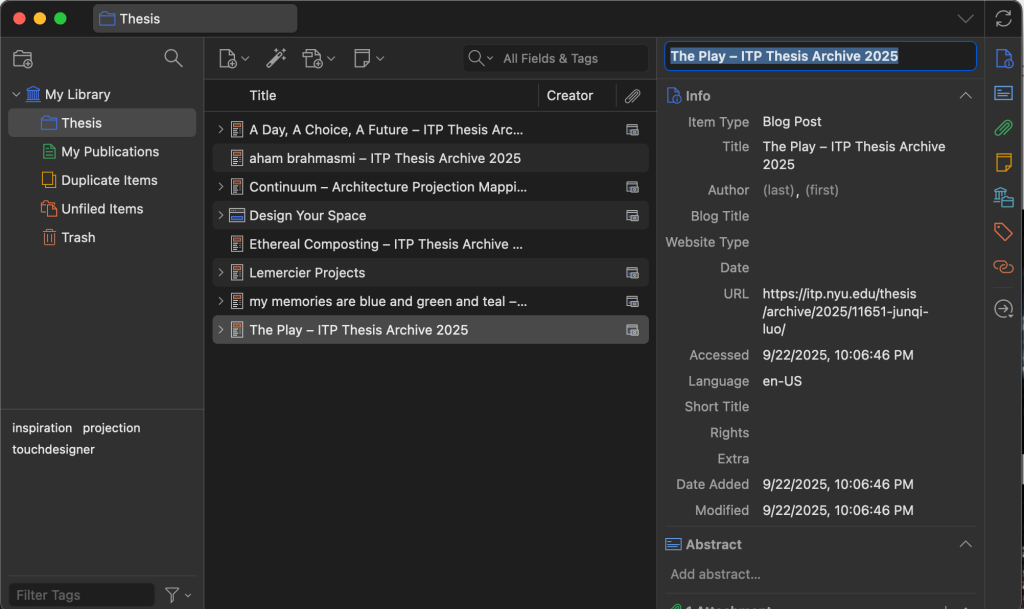
So far, my repository includes the three ITP thesis projects that resonated with my interests, plus Joanie Lemercier’s projection work as a key artistic reference, along with several other projects I’ve discovered through browsing the archives. This systematic approach helps me see patterns across different types of resources and quickly identify gaps where I need more examples.
This inquiry space continues to evolve as I discover new connections and deepen my research.
 Ryan Rotella
Leave a comment