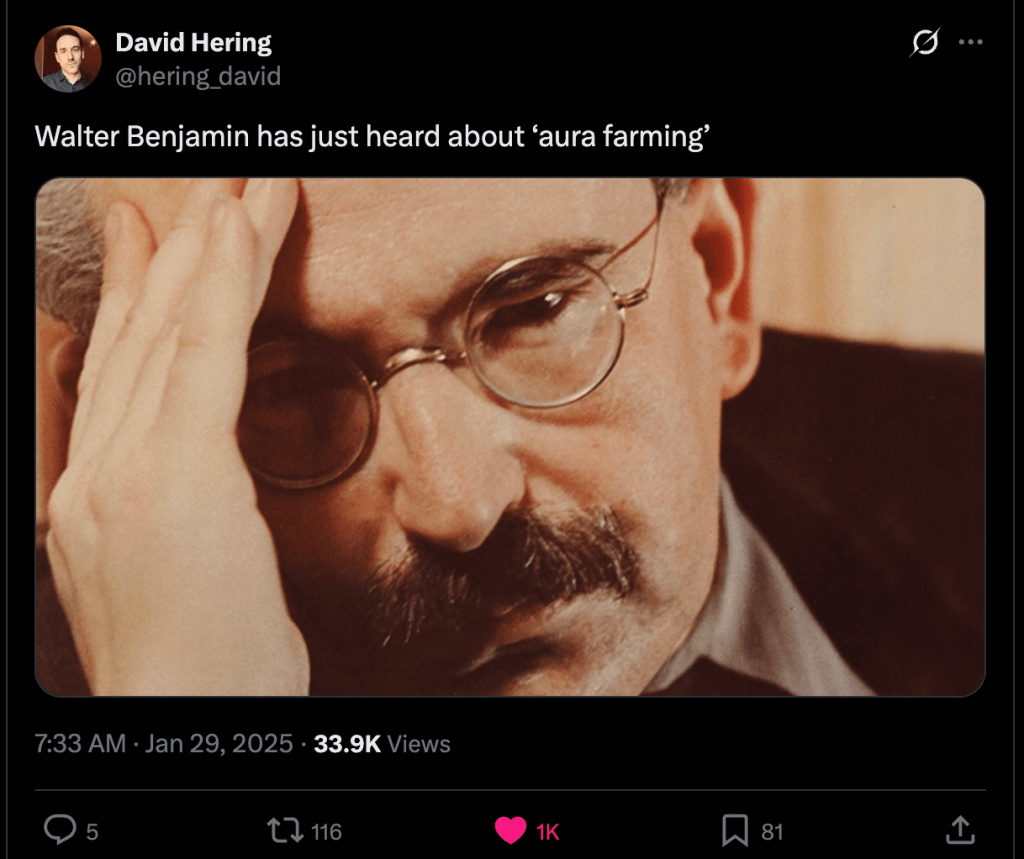
Walter Benjamin’s classic 1935 essay still has more meaningful things to say about art, politics, and modes of production than most of our discourse today. I felt this incongruity between past and current thought most in his passages on the use of distraction in filmmaking. Benjamin writes, “A man who concentrates before a work of art is absorbed by it. He enters into this work… In contrast, the distracted mass absorbs the work of art.” (18)
Benjamin argues that film in that time was much more effective than any other medium (painting, theater, etc.) at thrusting people to face their current world and tackle their reality directly. He pinpointed distraction as a way to break out of the abstract and alienate the viewer to absorb the habits set forth in a film.
At first blush, I recoiled at this. I can see why he valued distraction at destabilizing cultural power structures for his time, but for our time, a culture is one of constant destabilization. Images and videos invade our perceptions constantly now. Distraction is at an all time high in our society, where our attention spans are plummeting and our power structures are as oppressive as ever. Distraction has not stirred up the masses at all but placed them under a double dosage of overwhelming anxiety and escapist narcotic. Benjamin could not have foresaw this. I thought that the old guard would not know how to handle our current climate.
But then I thought more about what Benjamin was responding to in his time. In 1935 when Benjamin wrote this essay, Leni Riefenstahl, a Nazi filmmaker, made Triumph of the Will, the most famous Nazi propaganda. This film truly aestheticized politics with techniques that did unfortunately innovate filmmaking. This film is a premiere example of how the masses absorbed a work of art via distraction, and this context made me re-evaluate that Benjamin indeed anticipate our times. Social media now distracts us to the point of absorbing phrases and ideas that I never would have sought out ever. Benjamin’s framework is very critical for understanding why we have the media ecosystem we do today. Even as we struggle to politicize art in a way that mobilizes masses to organization and digital overwhelm has formed paralyzing habits and not active ones. Perhaps this is because the digital points us away from the things in front of us, toward a simulacrum (here’s to you, Derrida).
 Ryan Rotella
Leave a comment